At sea, a lighthouse helps ships find their way at night and in changing weather.
Black Amber's Lighthouse helps organisations find their way through AI transformations.
The platform guides an organisation from assessment through decisions to results. It shows where the organisation stands, what needs a decision next and what the work has delivered, with AI governance kept in the same record.
The cause is rarely the technology. It is the lack of one systematic, disciplined way to run the change, while the tools and the rules keep moving.
applies since 2 February 2025EU AI ActAI literacy duty for staff
applies since 17 January 2025DORAFinancial entities' ICT suppliers, AI tools included
applies since 25 May 2018GDPRPersonal data in AI tools, assessed if risk is high
The work sits in pieces
Tool lists with IT, policies with legal, training records with HR, use cases in slide decks. Each has its own owner and its own date and nobody sees the whole.
AI tools change weekly
Vendors add features, change their terms and move where data is processed. A list of AI tools starts to age on the day it is written.
Some duties already apply
The EU AI Act asks for AI literacy and sets other duties by risk class. Financial entities must also manage their AI suppliers under DORA.
Pilots stay pilots
Without a baseline, targets and owners, a pilot has nowhere to go next and nobody can show the board what has changed.
From pieces to one programme
One programmeDONE11%
AssessBaseline and gaps
DecideTargets, rules, budget
EnableSkills and champions
ExecuteUse cases and value
AI maturity assessmentStrategy office · Done once, in 2024Strategy office · Done
Tools in useIT · Spreadsheet from MarchIT · Done
Skills by roleHR · Never measuredHR · Done
AI value targetsExecutive team · Not in the business planExecutive team · Done
AI policyLegal · Draft 3Legal · Done
Use-case prioritiesSteering group · No agreed orderSteering group · Done
AI budgetFinance · Separate sheetFinance · In progress
Training by roleHR · Same course for allHR · Done
AI specialistsIT · One person knowsIT · Done
Team championsBusiness · Not namedBusiness · In progress
Use-case ownersBusiness · Pilots with no ownerBusiness · Done
AI-ready dataData office · Owned by nobodyData office · In progress
Daily AI useTeams · No baselineTeams · Next
Board reportBoard office · Rebuilt each quarterBoard office · In progress
Lighthouse gives the pieces one structure: four stages in the order the work happens, one owner for each fact and one current picture for everyone.
How Lighthouse works
One way of working, from the first assessment to AI in daily use
Lighthouse rests on one idea: see the whole transformation, choose what matters most and follow it through.
Where you stand
12345
Strategy & Value
Leadership & Sponsorship
1Governance & Risk
Literacy & Skills
Operating Model & Roles
2Another Area
Another Area
3Another Area
TodayGap to targetClose first
AI tool register
Each tool sits in the most sensitive data it may use
The AI tool market
Workplace
Coding
Business apps
Agents & orchestration
Gateways
Data
AI platforms
Models
Cloud
What's newEU data region addedChat assistant · 14 Oct
EU-run or self-hostedEU regionsNo EU guaranteeOn your list
What the rules ask for
In placeNot yet
AI skills by role group
Target 60%
Leadership78%
Risk & Compliance71%
Operations52%Train first
IT84%
Customer Service47%Train first
At or above targetBelow targetTarget 60%
Use cases
Idea2
Meeting summariesMinimal
Code generationMinimal
Approved1
CV screeningHigh
In build1
IT helpdeskLimited
Live2
Invoice processingMinimal
Customer service repliesLimited
Value realised1
Document searchMinimal
Owner · approver · risk class · link to Jira or Linear
Licence report.csvDropped in
AI suggests3 proposals
Add Meeting assistant to the list120 seats · source: row 14AcceptReject
Chat assistant renews on 1 MarchNotice by 1 Dec · source: row 3AcceptReject
Remove Image generator from the listNo seats found · source: row 22AcceptReject
A person decides every time
Board pack
Summary and decisions
Readiness and literacy
Use cases and AI tools
Risks, AI Act and actions
Made from the Lighthouse records
Assess
See where you stand
Leadership needs to know where to invest first and what progress will be measured against. An AI readiness assessment across eight areas, from strategy and leadership to governance and skills, rates each one against evidence and a target, so the gaps that matter most are clear.
Five levels, each described in plain words, so everyone reads a score the same way
A gap report for the board, with prioritised actions and an owner for each
Where you stand
12345
Strategy & Value
Leadership & Sponsorship
1Governance & Risk
Literacy & Skills
Operating Model & Roles
2Another Area
Another Area
3Another Area
TodayGap to targetClose first
Assess · Decide
Know every AI tool in use and what data each may access
AI tools nobody has reviewed carry risk and licences nobody uses add cost. Lighthouse keeps one AI tool register, including tools found in use, with each one's owner, the data it may access and its renewal date. Staff see which are approved and ask for what they need.
Licences used against licences bought and where two tools do the same job
Undecided tools, overdue checks and notice dates become actions with a clear next step
AI tool register
Each tool sits in the most sensitive data it may use
Decide
Keep up with a market that changes every week
Tools change their features, terms and data locations often and few teams have time to follow it all. Black Amber keeps a map of the enterprise AI tool market current, showing where each tool's AI processing runs, how hard it is to leave and what has changed. Changes to your own tools show on your list.
Every change is checked by a consultant, with the vendor's own source and date
Changes to EU rules appear in the same place, so there is one list to follow
The AI tool market
Workplace
Coding
Business apps
Agents & orchestration
Gateways
Data
AI platforms
Models
Cloud
What's newEU data region addedChat assistant · 14 Oct
EU-run or self-hostedEU regionsNo EU guaranteeOn your list
Decide
Meet the EU AI Act, DORA and the GDPR as the work happens
Evidence for regulators is far easier to keep as decisions are made than to rebuild afterwards. Each use case carries its AI Act risk class and whether you build the AI or use it as supplied. For financial entities, tools that support a critical or important function are marked and need an exit plan. Uses of personal data prompt a data protection check.
The AI literacy record names the tools people were trained on
Ratings and checks are Black Amber's assessment, with sources
What the rules ask for
In placeNot yet
Enable
Build AI skills where they are needed
We believe training changes how people work only when it is aimed at what they need and the tools they use. A skills check shows where people stand and what to work on. Results by group show where training time and budget will help most.
Results are shown by group, so individual results stay private
Results inform the AI literacy record and the assessment
AI skills by role group
Target 60%
Leadership78%
Risk & Compliance71%
Operations52%Train first
IT84%
Customer Service47%Train first
At or above targetBelow targetTarget 60%
Execute
Move the work and its use cases from idea to value
Value comes from changing how the work runs, with use cases as its steps or standing alone. A use case counts when someone owns it, someone has approved it and its result is measured. Lighthouse follows each one from first idea to delivered value, with its owner, approver and AI Act risk class. Each links to the team's own project in Jira or Linear, where delivery already runs.
Use cases attach to real processes, with a baseline and a target to measure the gain against
Existing lists come in from a spreadsheet, with differences shown for a person to accept
Use cases
Idea2
Meeting summariesMinimal
Code generationMinimal
Approved1
CV screeningHigh
In build1
IT helpdeskLimited
Live2
Invoice processingMinimal
Customer service repliesLimited
Value realised1
Document searchMinimal
Owner · approver · risk class · link to Jira or Linear
Throughout
Let AI do the busy work and keep the decisions
Records that fall behind soon stop being trusted and few teams have time to keep them current. Paste or drop what you already have, such as a licence report or meeting minutes. AI reads it and proposes the changes, each with its source. A person accepts or rejects each one and nothing changes until they do.
Less of your team's time goes on upkeep and more on decisions
Every accepted change stays in the history, with the person who accepted it
Licence report.csvDropped in
AI suggests3 proposals
Add Meeting assistant to the list120 seats · source: row 14AcceptReject
Chat assistant renews on 1 MarchNotice by 1 Dec · source: row 3AcceptReject
Remove Image generator from the listNo seats found · source: row 22AcceptReject
A person decides every time
Throughout
Show the board where you stand
Boards need a clear view of progress and of the decisions waiting for them, without a separate reporting exercise. A report for the board, made from the records, covers the overall status and open decisions, readiness and literacy, use cases and AI tools, the main risks and actions.
The figures come straight from the records, so nothing is copied by hand
Your team can open it at any time and take it to the board
Board pack
Summary and decisions
Readiness and literacy
Use cases and AI tools
Risks, AI Act and actions
Made from the Lighthouse records
One record
Each part makes the others better
What you learn about your tools, your people and your use cases feeds the picture of where you stand. The gaps then become a short list of actions for the board. We believe skills, tools, decisions and the work itself have to change together. Lighthouse keeps them in one record, so each part can be seen against the others.
Keeper
Keeper reads the whole record and prepares the next step
Keeper is the AI assistant inside Lighthouse. It reads where you stand, your use cases, your AI tools and your people's skills together and points to what deserves attention. It prepares the change. A person decides.
It sees across the parts
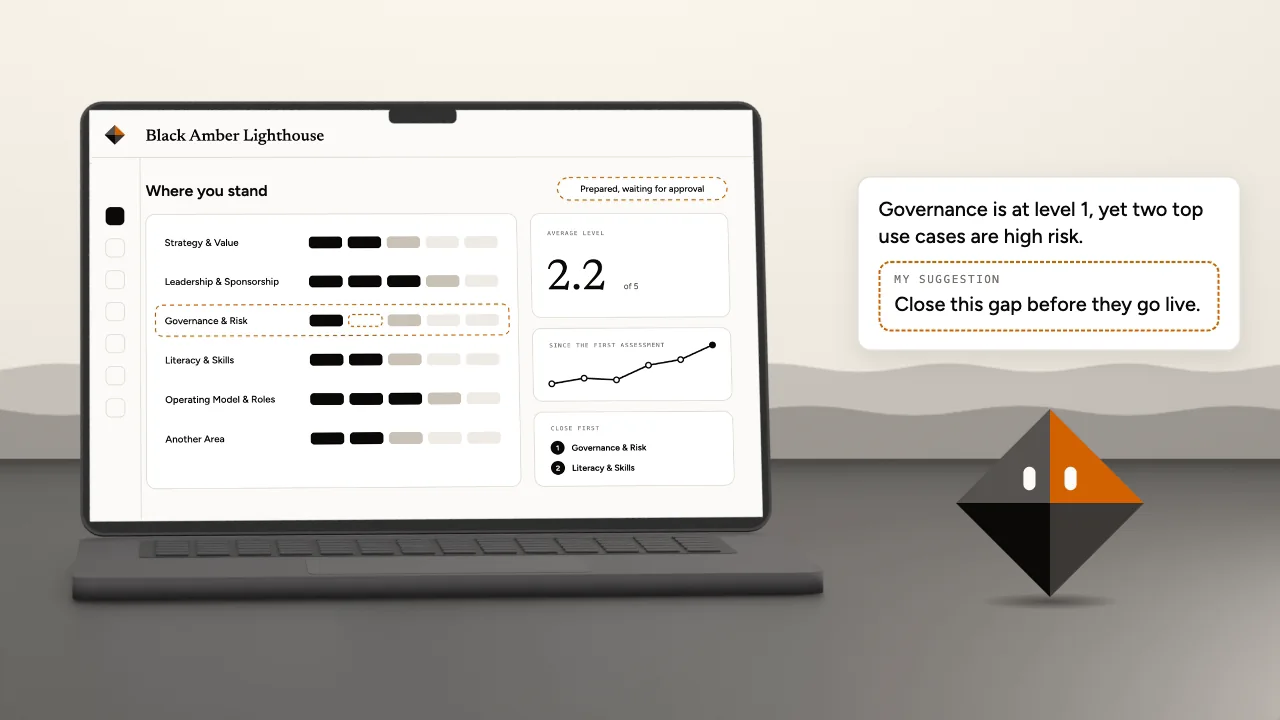
A gap in governance next to a high-risk use case. A skills result next to the work that needs it. Keeper finds what you would only see with every screen open at once.
It prepares and you decide
Keeper drafts the change: a score, a tool's entry, a use case. Nothing changes until a person accepts it and what AI prepared stays marked as such.
It answers from your record
Ask in plain words. The answer comes from your own data, with a link to the place it stands in Lighthouse.
The camera moves in to the lighthouse's lamp and into a room where Keeper, a small stone figure, stands beside a laptop. The laptop shows four parts of Lighthouse in turn. For each, Keeper gives one finding and one suggestion.
Governance is at level 1, yet two top use cases are high risk. Close this gap before they go live.
Invoice processing is easier than scored: its tool is already approved. Raise its feasibility. It joins the top three.
A vendor changed its data terms last week. The tool is on your register. Review the entry. Two use cases rely on it.
Only 3 in 10 managers reach the level their role needs. Train managers first. Staff and technical teams are already there.
Context for AI assistants
An AI assistant that knows your AI transformation
Lighthouse holds what an AI assistant needs to know about your AI initiatives. The assistant reads this record through Lighthouse's MCP server and proposes changes. A person decides. Black Amber's consultants connect Claude to it. Connecting your organisation's own assistant is available on request.
Read“HR wants to screen CVs with AI. Is anything similar approved and what would the approval process ask for?”Draws on use cases, risk classes and approvals
Read“The organisation is thinking of buying an AI legal assistant. Does it already have one that does the same and what would it need before approval?”Draws on the AI tool register and the AI tool market map
Propose“Read this week's steering notes in Notion and propose the use cases agreed.”Draws on the notes and the use cases already there
Your team can run Lighthouse day to day, as a product of its own, with Black Amber in the background.
Your team would
Keep the record, run the skills check and decide on tools and use cases.
Black Amber would
Keep the market map and the rule updates current, with a consultant there when you want one.
AVAILABLE ON REQUEST
Questions
What clients ask before they start
Who is Lighthouse for?
Organisations running an AI transformation that want one record of where it stands: the AI tools in use, people's skills, the use cases and the rules that apply. That includes DORA for financial firms and the EU AI Act for organisations that use AI in their work.
Does the AI make decisions?
No. AI does the upkeep, such as reading documents and proposing updates. People make every decision. An administrator sets what each person's AI assistant may do. Deletes, roles and passwords never change through an AI assistant.
Which AI assistants work with Lighthouse?
Lighthouse has an MCP server, the open standard AI assistants use to work with other systems. Claude can connect to it. Connecting your organisation's assistant is available on request.
Does Lighthouse connect to Jira, Slack or Microsoft Teams?
Not directly. Your AI assistant reaches those tools through its own connectors and carries the work between them and Lighthouse.
Can our own team run Lighthouse?
Today Black Amber's consultants run the engagement in Lighthouse together with your team, both working from the same record. Running Lighthouse with your own team is available on request.
Is Lighthouse legal advice?
No. Lighthouse keeps duties from the EU AI Act, DORA and the GDPR in the record as the work happens, each with its source. It does not replace advice from your lawyers.
Request a demo
A partner walks through Lighthouse on an example organisation, then answers questions about your own organisation.
Where an example organisation stands and its first gaps
Its AI tools, checked against the market and the rules